API Reference Guide
14/08/2026
Rural Roads Speed Limit Analysis 2026
24/11/2026News:
Speed Limit Dashboard evidence updated
Latest data citied in evidence in the Houses of Parliament at the PACTS Council of Members Meeting

The National Picture
This quarter's update from Insight Warehouse's GB Speed Limit Dashboard featured in a presentation to MPs and experts as a part of a dicussion on Safety Performance Indicators in Committee Room 6 in the Palace of Westminster.
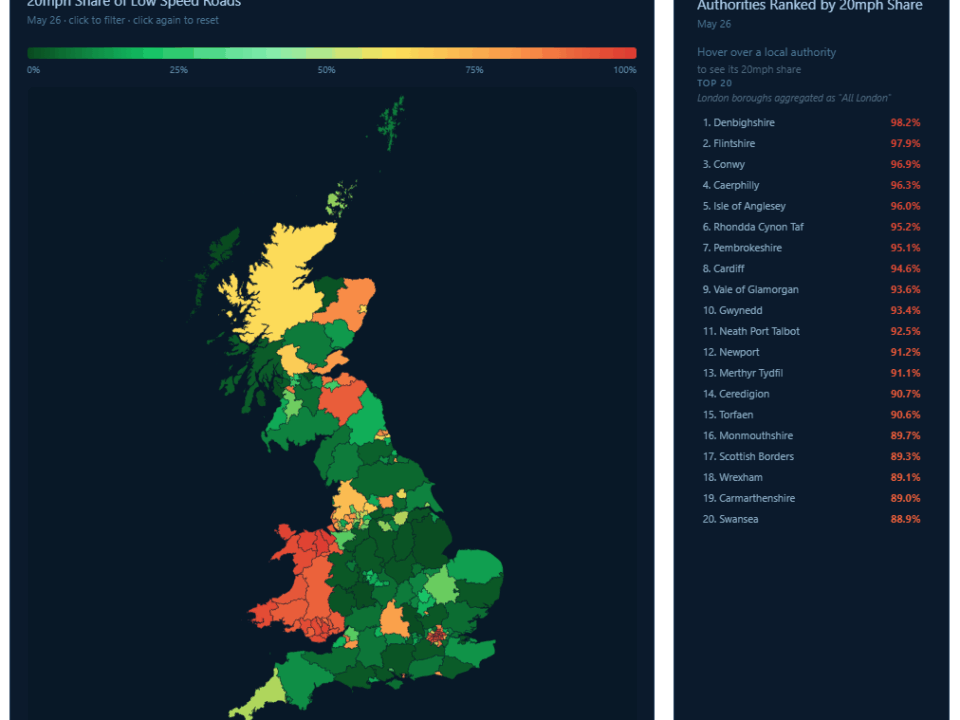
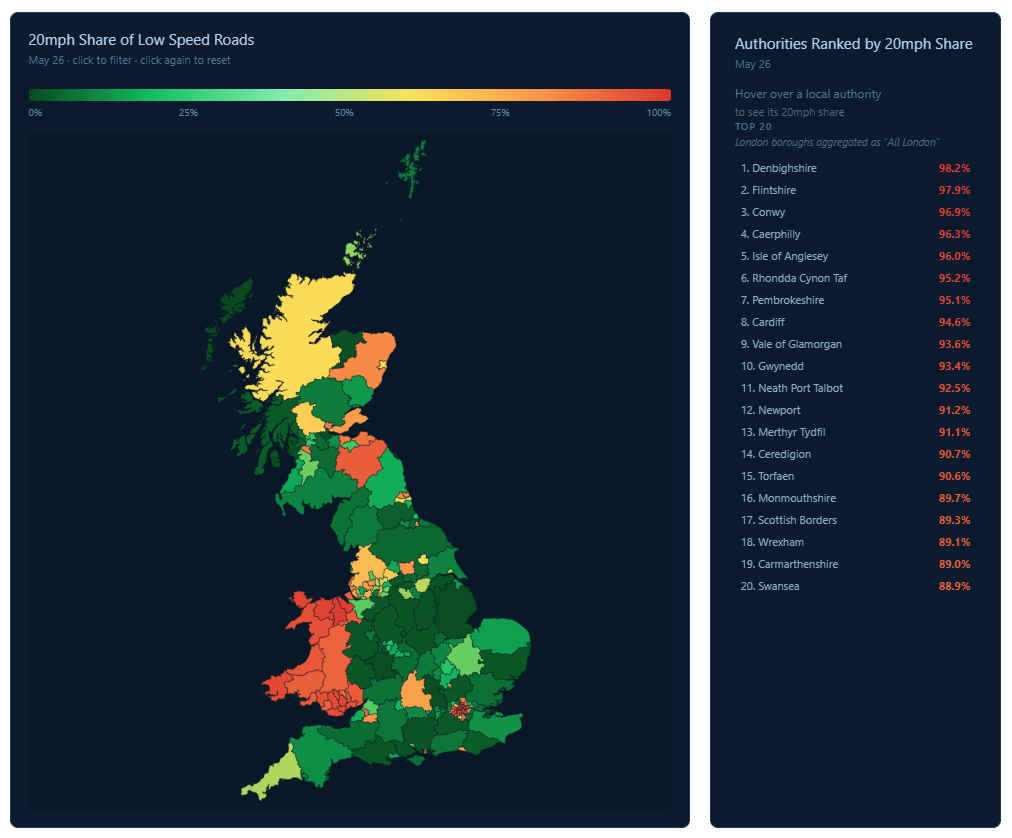
Data source: Insight Warehouse GB Speed Limit Dashboard, November 2026. Covers 207 Highway Authorities in Great Britain. 20mph share calculated as a proportion of combined 20mph and 30mph road length.
Dashboard includes data for strategic roads within authority areas that are not under the control of the highway authority.
The latest update to IW's GB Speed Limit Dashboard, covering data to November 2026, shows that 20mph limits now apply to 71,830 km of Great Britain's road network — an increase of 381 km compared to the previous period (August 2026). Over the same period, 30mph roads fell by 495 km to 158,994 km, consistent with a pattern of direct conversion from 30mph to 20mph that has been visible across the full tracking period. The net figure includes a reduction of 292 km in Enfield; across the rest of Great Britain, 20mph road length rose by 673 km.
The 20mph share of low-speed roads (those designated at either 20mph or 30mph) now stands at 31.1%, up from 30.9% in August. While the quarter-on-quarter increase of 0.2 percentage points is modest, the share has risen in every period in the dataset.
The overall size of the road network tracked in the dashboard remains stable at around 431,100 km across all speed categories, indicating that new 20mph designations are almost entirely being set on roads previously classified as 30mph, rather than representing new road construction.
The November 2026 data shows steady, but geographically uneven progress. Wales remains the benchmark nationally, with a combined 20mph share of 92.1% that is essentially unchanged on August. In England (25.7%) and Scotland (37.0%), change is being driven authority-by-authority, with Hertfordshire and a group of outer London boroughs the most active movers in the latest period, while Scotland saw almost no net movement. The gap between the most and least active authorities — from 100% to 0% — underlines how much the pace of change continues to depend on individual local authority policy decisions rather than any national mandate in England or Scotland.
Of the 207 Highway Authorities tracked in the dashboard, 152 saw no meaningful change (under 1 km) in their 20mph road length between August and November 2026, suggesting that progress nationally remains concentrated in a relatively small number of active authorities in any given quarter.

Hertfordshire leads the way
Hertfordshire recorded the largest absolute increase in 20mph road length of any authority in Great Britain between August and November 2026, adding 126 km of 20mph road — around double its nearest rival, Bradford (+62 km). Its 20mph share of low-speed roads rose by 3.6 percentage points to 6.7%. The 30mph network in Hertfordshire fell by a similar 133 km over the same period, confirming that the change is driven by reclassification rather than new build.

Waltham Forest, Redbridge and Barnet record the biggest shifts in share
Waltham Forest saw the biggest percentage-point shift of any authority in GB, with its 20mph share rising 12.8 percentage points — from 82.0% in August to 94.8% in November. Redbridge (21.7% to 33.1%) and Barnet (7.6% to 15.2%) also moved sharply, each adding close to 60 km of 20mph roads, again matched by a near-equivalent reduction in 30mph length.

Welsh authorities remain the national benchmark
Wales continues to set the pace nationally, reflecting the Welsh Government's national 20mph default on restricted roads, which came into force in September 2023. Denbighshire (98.1%), Flintshire (96.8%), Caerphilly (95.5%) and Conwy (95.3%) all sit above 95%, and the combined Welsh share of 92.1% is essentially unchanged since August. Conwy recorded the only notable movement, with its 20mph road length falling by 7 km and its share dropping 1.6 percentage points from 96.9%.
London: stable overall, with movement beneath
London's 33 boroughs, when combined, have a 20mph share of 63.2%, up marginally from 63.1% in August. The net gain of around 25 km conceals considerable movement: 20 boroughs added 20mph road (317 km in total, led by Waltham Forest, Redbridge, Barnet, Ealing and Harrow), offset by a reduction of 292 km in Enfield, where the 20mph share fell from 79.7% to 33.7% with a near-equivalent increase in 30mph length. This figure was changed following close work with Transport for London and a review of TROs that were proposed but not implemented. The City of London and Islington remain at effectively 100%, with Camden (99.9%) and Southwark (99.8%) just behind.